by Connie Habash | Mar 20, 2014 | Awareness, Centered, Mindfulness, Now, Presence, stillness
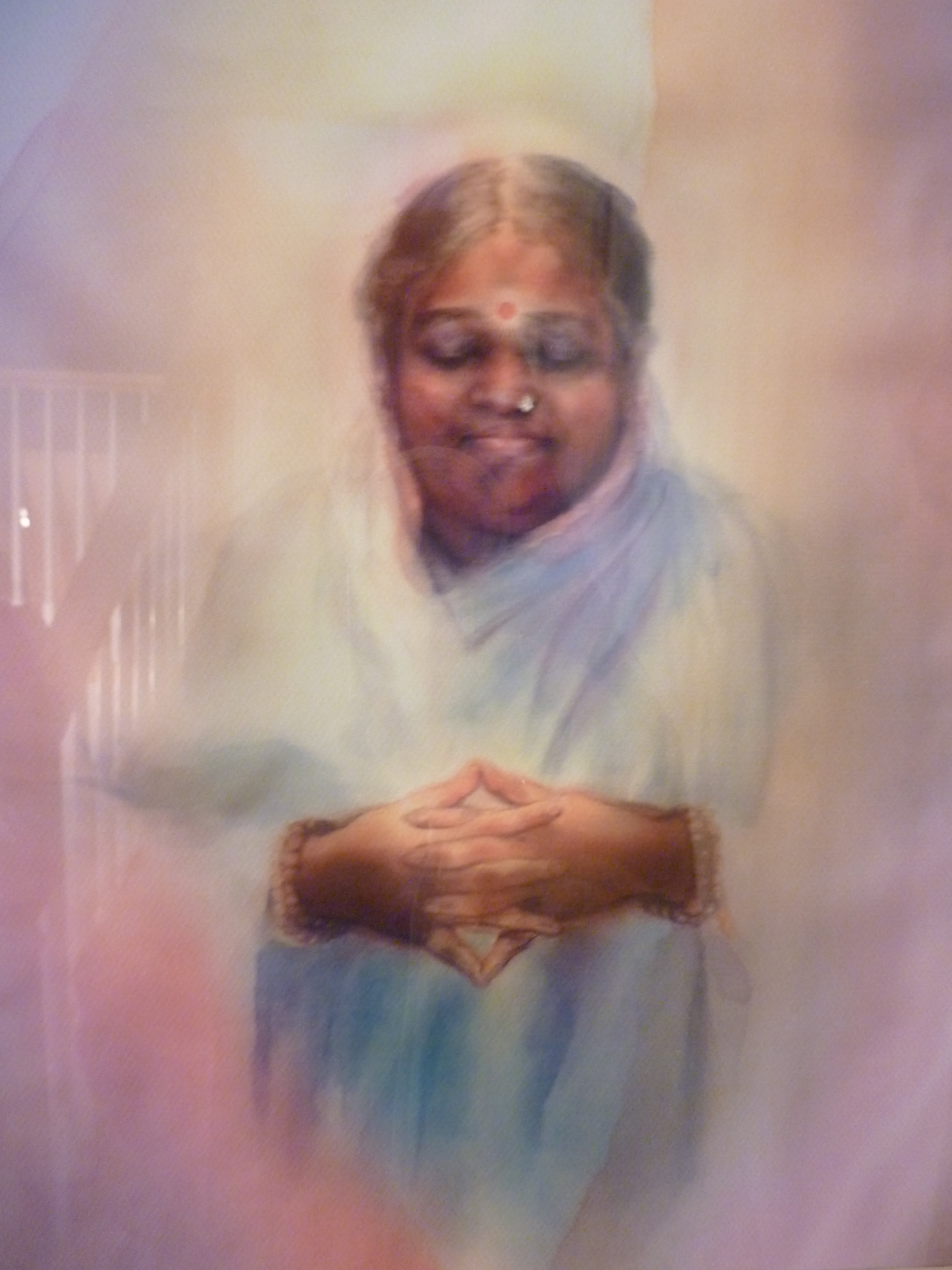
I have this painting you see here on my stairway. It’s a print of a watercolor of my spiritual teacher, Amma. I fell in love with it a few years ago, and knew it would look lovely on the landing of our stairs.
Every day, as I descend the 7 steps at the top of our staircase, I pause facing her image. Her eyes are closed and she has radiance beaming from her third eye in the center of her forehead. She holds her hands reverently, just above her solar plexus, in some sort of mudra – similar to folding them in prayer, but the tips of the little and index fingers touch.
Every time I come down the stairs, I take a few moments to pause with her image. I, too, close my eyes, and take a mindful breath. I put my hands in the mudra, and imagine the light at my 6th chakra. I silence my mind, if only for a moment.
This practice gives me mindful pauses to become present throughout the day. As I am going up and downstairs, toting baskets of laundry, I stop and breathe. When I first come downstairs in the morning for breakfast, I pause and come into the moment. I am reminded of what is truly important. I feel refreshed.
You, too, can create a special place in your home to help you practice more presence and stillness. Find an image that deeply touches your soul. It can be a painting, photo, statue, crystal, or a candle – anything that stands out to you that you can put in a prominent place, one that you’ll pass by regularly throughout the time you are at home.
Make it a practice to stop, even if just for one breath, be still, and feel your Divine self. Let your thoughts wash away with your exhale. Allow yourself to feel free and open right now. Know that this moment is a good moment. Receive the Divine Light. This will refresh you and keep you focused on your spiritual path.
Where in your home can you create that sacred place to pause and be present?
by Connie Habash | Mar 5, 2014 | Acceptance, Appreciation, Buddha, Centered, Comparison, Depression, Happiness, Mindfulness, Now, Presence
The mind likes to do a lot of comparing. Am I doing as well as that person over there? My yoga poses suck. I am the best in the class! Their car is nicer than mine. It would be easy to write pages of this, wouldn’t it? It’s all too familiar.
In my years as a counselor, it’s become apparent to me that comparison is the root of depression. We wish things were different than they are, and we tend to focus on what we don’t have, or what isn’t happening right now. This is a sure-fire way to ruin your mood, and it does nothing for creating what you really want.
The Buddha might say that by comparing, you are creating more suffering, for you create the desire to be a certain way or have certain things. Patanjali, the father of yogic philosophy, would point out that Raga – attachment – and Dvesha – aversion – are two of the five causes of affliction, the Kleshas. When we get into comparison, it’s just another disguise for how we cling to what we want and push away what we don’t.
How do we get off of the hamster wheel of comparison? Pull all your attention back to your center. Be where you are. Don’t resist what is – when you embrace it, and learn to be with it, it will begin to shift.
Part of why undesirable situations continue is that we continue to resist them, which gives them more power in our lives. When you bring your attention back within to the Self, that which watches all these mental games, we begin to see things from a different perspective. Then, with clear perspective, you can choose how you want to respond, rather than be in reaction to what is.
One great choice is the practice of gratitude. It is scientifically shown in studies that gratitude is one of the most powerful ways to relieve depression.
Comparison is the opposite of gratitude – it takes us away from recognition of the good that is, and either makes us feel lacking, or makes us believe that we’ve got something that someone else doesn’t. Either way, it takes us out of the deep appreciation that comes from receiving blessings in our life and seeing others receive, too. The deepest practice of gratitude is when we can feel deep appreciation and celebration for what others have.
Start with the little things – gratitude for the sunrise in the morning, for the gas in your tank, the next door neighbor who picks up your mail when you’re gone. Perhaps you can feel gratitude for your next breath… or just being able to get out of bed in the morning.
How about gratitude for your underwear? A little sense of humor can take you out of that comparing mind into simple appreciation in the present. Laughter happens in the here and now, and when we laugh, the mind can’t stay stuck in feeling better or worse – it just is being with what is.
We take ourselves so seriously, and when you step back and think about it, there’s a lot of humor happening there. Like, why do I get so serious when flossing my teeth? Or why do a few ants in the kitchen make me behave as if the world has come to an end? And why do I still unconsciously avoid cracks in the sidewalk like I did as a child? Isn’t that silly?
You can ask yourself the same questions when you find yourself comparing. Why does it matter whether I did that yoga pose better or worse the other day? You’re in this moment, not the past. Who else is judging except you?
Don’t despair if you find yourself in “comparing mind”. Let go, be with what is. Bring yourself back to your center, the place where you’re watching what is happening, and recognize that it transcends comparison. Feel gratitude and appreciation for everything you can. And find something to laugh about, because the universe is full of absurdity, including how seriously you compare yourself to others. Then you can let go of comparing – I am not better or worse than; I just AM.
by Connie Habash | Feb 12, 2013 | Acceptance, Appreciation, Impermanence, Now, Presence
My 8 year old daughter asked me last night, “Why is it called Butterfly? What does butter have to do with it? Who came up with that name?” I had to admit I didn’t know. But it made me think of how often we use words or phrases without paying much attention to what we’re actually saying.
For instance, I heard a familiar phrase today as if for the first time: “It came to pass.” It’s commonly found in the bible, as a kick-starter for some sort of story or allegory. Hmmm… to pass. That means something was temporary, a happening. Something was just moving on through, as time passes by. After all, the phrase isn’t “it came to stay.”
It speaks of the temporary nature of everything. The universe is constantly changing. You and I are constantly changing. You can’t hold onto to anything, just like you can’t cling to water. Everything is going to pass – even this life.
This keeps me in the present moment. I’d do well to enjoy this now, to be present with this now, because in the next moment it will have passed… and something new will emerge.
I’m in pain? It will pass. What is it like? How does this experience touch me and teach me?
I’m in joy? It will pass. What is it like? How can I appreciate it without clinging to it? What does it reveal?
The only thing – absolutely the only thing – that doesn’t pass is the consciousness with which we watch everything passing. That’s the Source. There’s only One Presence that witnesses it all, and it’s our True Nature.
Otherwise, we’d have no One reading “it came to pass…”
by Connie Habash | Jan 23, 2013 | Blessings, Happiness, Now, Receiving, Seeking, Serendipity
I’ve spent a lot of my life seeking, seeking, seeking. Looking for God everywhere, searching for my teacher or my spiritual path.
Today, I was looking for space to store my daughter’s Christmas ornaments, and opened up the hall closet. There’s just enough room to fit the box up high on the shelf above the coats. But wait – what’s that green tassel I see?
I pulled it out, and there was my favorite multi-colored fleece cap that matches my favorite multi-colored muffler. A few years ago, I despaired for quite some time about the loss of that hat, figuring someone stole it when I left it behind at a restaurant. What joy! Just finding that little cap brought such happiness.
I wasn’t even looking for it. But there it was – I had it all along. Finding is much easier and more fun than seeking.
What else might I find if I stop seeking? What if I spent each day knowing that I’m going to find, without seeking? What if there is something ready to find in every moment?
I’m ready to find out!
by Connie Habash | Oct 31, 2012 | Acceptance, Buddha, Choices, Happiness, Illusion, Judgment, Nonattachment, Now, Presence, Right Action
The funniest thought arose in my meditation today, after I had been contemplating the Eightfold Noble Path – Buddha’s prescription for eradicating suffering and attaining liberation. Apparently, my thoughts weren’t entirely still (big surprise) and thus this image of an ice cream cone being offered to the Buddha somehow sprang to my awareness. Would he eat it? What would the Buddha do?
I can’t claim to know what the Buddha would do, to be quite frank. But, based on his teachings, I can certainly take a stab at it. There’s one thing I do know – the Buddha would be aware that he has choices. He can choose to eat it, he can choose not to eat it. He would know that any desire or aversion that arose regarding the ice cream would be continuing the cycle of suffering in this life. He also knows that judgment would be a slippery slope – it feeds the ego, the idea that we are right if we choose one way, and wrong if we choose another. This would lead to either pride or shame, which again is back on the hamster wheel of suffering.

Therefore, he couldn’t say “No! It is wrong to eat ice cream – it’s bad for you, and will increase your desires, and therefore your suffering!” He also couldn’t simply indulge, giving in to a craving for the sweetness. He would probably be considering what Right Action to take – one of teachings of the Eightfold Path. What’s a Buddha to do?
He could decide not to eat it, plain and simple. He could decide not to eat it, but thank the person who offered it for their kindness in the offering. He could decide to taste it and experience the pleasantness of the flavor and texture as an expression of Maya, or the illusory state of the material world. He could decide to eat it, and recognize the temporary experience of the ice cream, from its taste on the tongue to how quickly it melts. He could eat it or not eat it, and recognize that the pleasure or pain he experienced from either choice is not his true nature, and that eating it or not eating it will not give him true happiness. Who really knows what the Buddha would do?
But one thing is for sure – whatever he chooses, he will forget about it in the next instant. He won’t even be thinking about the ice cream ever again, because he is firmly established in the eternal now, the ultimate reality, that transcends any of the temporary fluctuations of thought or form. So once he did whatever he did, he’d be done with it.
What do you think the Buddha would do?