by Connie Habash | Oct 12, 2020 | Consciousness, Let Go, Presence, Receiving, Release, Seasons, Thoughts, Transformation

It’s autumn: the season to reflect. What better time to recognize the thoughts, beliefs, attitudes, and perceptions that hold us back, and use the energies of autumn to transform them through the 5 R’s: reminisce, reflect, review, release, and receive.
Science has discovered that we have tens of thousands of thoughts every day. Everything from the mundane, “oh, the light is turning red” to more profound, unique, abstract ideas.
But the majority of our thoughts, if we’re being honest with ourselves, are not novel or unique. They re-hash, over and over, old perceptions, attitudes, and belief systems that accompanied us from childhood.
Because they aren’t unusual or insightful, we don’t even notice these old, repetitive thoughts. Unfortunately, that means they carry a lot of influence on our mood, behavior, and reactions to life. They fly under the radar in our subconscious or even unconscious mind.
If we want to create change in our lives (let alone in our world), it’s essential that we bring to conscious awareness what thoughts are happening within us. We need to unearth what affects us under the surface.
Our Inner Sewage System
It’s like the sewage system: in our city, most of the time, we aren’t aware of all that poopy yuck flowing under us. But someone is – the people in charge of keeping the sewers clean, those who run the sewage treatment plants, and of course the departments that administrate all of that, all the way up to the city mayor or the county Department of Health.
I’m not going to spend my time or yours going into the details of all that, but the point is that there is a lot going on beyond our awareness that affects our well-being in the world, and that goes for inside our mind, too. Thoughts, like the sewer systems, need to be brought to awareness and either utilized or cleaned out. We need to have our inner head of the Department of Mental Health on the job to keep our system clean, spacious, and flowing with fresh, healthy waters of consciousness.
Since it’s autumn, the season of letting go – and allowing what no longer has life to decompose – it’s a good time to release, compost, and renew our thoughts and mind.
Autumn’s inward time supports work with the “re-” words: reminisce, reflect, review, release, and receive. These 5 “R’s” will help you become aware of what thoughts you’re having, where they have come from, and how to change and release them, leaving you with a renewed perspective. Take a little time to look inside yourself – and break out a journal if you can – to experience some transformation in your mind.
Reminisce
Autumn is a great time to look back on life. There’s something about the falling leaves that always has me think about the past. If you have become aware of certain thoughts that are causing you trouble – such as thoughts of self-doubt, for example – you can be sure that one or more events in your past initiated that train of thought.
Look back to the earliest time you can remember feeling that way. Journal about it – what happened, who was there, how did you feel, and what conclusions did you come to?
Reflect
Now, take your recalled memory a little deeper, and reflect on what happened as a result of that. If you were to sum up that issue in one sentence of what you believed about yourself or life, what would it be? Write it down.
Reflect also on all the ways in which that belief has played out in your life. Consider how it affected your decision making, and influenced the way you perceived others, situations, and yourself. Again, journal your reflections and insights about this belief (and you may unearth “corollaries” to that belief that branched off into other areas of your life and reinforced it).
Review
Now, look at your beliefs that you have identified. Consider viewing the situations that initiated them from a different perspective. Did you misinterpret something and lived off of that conclusion? Were the other people involved only reacting from their unconscious beliefs, rather than actually seeing and understanding you? Were you unnecessarily hard on yourself? Did you absorb the beliefs of a parent or other influential person in your life without recognizing you had other choices?
Re-view: consider a new point of view that leads to a different conclusion and a more helpful belief. I find that Byron Katie’s “The Work” is really helpful and powerful here. She uses a practice called “the turnaround” that gives a very different perspective on a belief.
For example, you might have the belief, “Everyone demands so much of me.” You’d probably be a very busy individual, with a lot of people that depend on you. But with the turnaround, you may realize something else is going on besides a bunch of people grabbing all yourr energy and attention. In fact, it may not be true at all. With the turnaround, you shift the thought into its opposite, and often it reveals something more true than the original belief.
You could turn around a belief like this – “Everyone demands so much of me” – in a variety of ways:
- No one demands so much of me – how many people are directly asking for things and expecting them? With a reality check, maybe not so many.
- Everyone demands so little of me – perhaps they aren’t asking for anything, but you keep yourself incredibly busy in order to feel special and needed?
- I demand so much of me – You might be extremely self-critical, and you’re the one putting all the pressure on yourself, not anyone else
- I demand so little of everyone else – Are you taking on things for others that you don’t need to? Are you being codependent and doing things for others that they should do for themselves?
After doing a turnaround, you re-view – you discover a fresh perspective. You can choose a new belief about yourself and life that works better for you.
Release
Finally, just like the trees do with their foliage, consider releasing the thoughts altogether. It’s much easier to let go of unhealthy thoughts and beliefs when you’ve gone through the process of reminisce, reflect, and review, because it takes the mystery and power out of them. Now, you’re just seeing them as a thought and not “the way that it is.”
Ultimately, none of the thoughts are true – they are simply different ways to perceive and react. Just like the leaves, at one point in your life they probably served a purpose, but that time is long over. Thoughts should be used to serve a helpful purpose, and then released so that new inspiration can flow.
Have some fun with releasing thoughts – write them on little pieces of paper, and then do a “burning bowl” ceremony (but remember to be safe – have some water nearby to put out the fire!). You can burn them over a sink, if you wish. As you watch the paper go up in flame, imagine all of those beliefs and perceptions disappear in the smoke, leaving you with clarity and peace.
The practice of Presence, too, helps to release our thinking mind, open our hearts, and come fully into this moment. Rather than telling the thoughts to go away (that doesn’t usually work so well!), shift your attention to what is right here, right now. Use your 5 senses to help you discern that.
Chances are good that none of those thoughts are happening right now. And even if they are – if you’re seeing an apple in a tree and telling yourself, “there’s a green apple on that branch”, the thought is not the same thing as the reality. You can’t bite into a thought like you can that apple. Be Present, with a quiet mind and open heart, right there with the apple. See it; perhaps touch it and smell it. Just sit there with it, releasing the thoughts about it and keep turning your attention back to the apple. Sooner or later, the mind quiets down and immerses in the object of your attention.
Receive
Releasing thoughts renews your energy and allows you to receive that energy back. Imagine leaves, dropped from the trees above, composting on the forest floor. All of that compost returns nutrients to the soil, which continue to support the life of the ecosystem. When you let go of thoughts, you receive back all the energy you were expending on them. Releasing unnecessary, unhelpful beliefs and attitudes recharges your body and mind. That’s some powerful thought composting!
When you release the thoughts that no longer support you, you’ll also discover some inner spaciousness. There’s a feeling of ease. In that spaciousness within us, we can receive the blessings that life offers us.
When we practice Presence, it is more than just being there with the apple; it’s receiving the apple’s Presence with you. Everything in life offers us something in the present moment. The apple is already Present: it’s simply being itself. Fully. No thoughts in the way of just being. Receive that gift of Presence, and feel how Presence is two-way: it’s a flowing connection with All That Is.
Remember!
So while you’re enjoying the changes of the fall season, remember to change your mind, too. Bring those unconscious thoughts, beliefs, and perceptions to the surface of your awareness. It’s the perfect time to transform them through the 5 “R’s”: reminisce, reflect, review, release, and receive. Allow autumn to support you in new beliefs and perspectives – or, like the leaves, let go of them altogether.
What are you discovering with the 5 “R’s”? Leave your thoughts here (pun intended!).
by Connie Habash | Oct 1, 2018 | Acceptance, Anxiety, Control, Let Go

Trying to control creates anxiety – but letting go brings me ease.
A half hour before writing this blog, I fixed myself some lunch. I was making a salad, and needed to peel some cucumbers. Wanting the peels to be easy to clean up, I had a compost box in front of me and set out to peel over it, so the skins would land right into the box and there’d be no clean up.
After 3 whips of my veggie peeler, I had flung 2 of the peels onto the floor.
It wasn’t that I wasn’t present enough. I was relaxed, breathing, and focused on my task. It’s simply the fact that you can’t control everything (or maybe that I suck at peeling cucumbers).
I often find myself wanting to control situations – you, too? There’s nothing wrong with planning ahead, like I did. I was ready to catch those cucumber peels. Being present in the moment also is helpful, and it allowed me to have a relatively calm and quiet mind while I set out to prepare my salad. But I wanted a certain outcome – those peels should have fallen right into the cardboard box!
I had to laugh at myself, because I know that I like to control outcomes. I do it throughout my day, wanting traffic to be just right, no red lights, to show up early to pick up my daughter, to get the next chapter in my book finished in a half-hour. But try as I might, life is still unpredictable.
In the past, I might have gotten angry and frustrated. “Those darn peels! I think I need a new peeler, it’s just not working right. I should have paid more attention – I must have been doing something wrong! Why does this always seem to happen? Cooking sucks.” My thoughts could have gotten me all in a tizzy, increasing my stress and anxiety not only for the task at hand, but for future simple cooking endeavors.
Instead, it was just funny. Who spills 2/3 of their peels on the floor? Well, apparently me today! Try as I might to be as spiritually aware, present, and attentive to the task, it still may not go as planned. And that’s OK.
What freedom there was in just letting go. What ease in releasing the judgments and comparisons, and finding humor in the unpredictability of life – and my veggie peeler. My tension released.
What is unpredictable in your life right now? How might you let go? What new perspective could you have about it? You’re not alone in your frustrations when life doesn’t go as planned. Share it here!
by Connie Habash | Nov 19, 2017 | Acceptance, Challenges, Choices, Divine, Gratitude, Let Go, Mindfulness, Presence, Release, Seasons, Self-Care
Thanksgiving: a unique American holiday that is universal, unlimited by religion, race, or any category. It’s a special time to come together with family and friends to feel gratitude on this day of the celebration of abundance (oh yeah, and feasting!).
But for some of us, this isn’t an entirely pleasant holiday. We may be faced with “going home” to tension, crazy family dynamics, feeling ignored or attacked, possibly being the black sheep of the family. Perhaps you are hosting a large gathering, and stressed about pleasing everyone’s palates – or having everyone in your house! There may be a recent loss in the family that makes holidays, especially the most family-oriented one of the year, somewhat painful. Or we may be apart from our family, or feel that we don’t have one, and are faced with spending this holiday alone.
I have found myself in most of these scenarios at some point in my life. It’s difficult, and you’re not alone if you feel this way. But I have found, over the years, some ways to make Thanksgiving easier, more meaningful, and more fulfilling, no matter if you have a wonderful, warm family to spend it with or you find yourself feeling stressed and left out of the loop.
- Let go of expectations – Expectations increase the risk of disappointment. If you’re going home, set the intention to flow with whatever arises. You have what you need within you to respond appropriately. Having everyone over? Relax and accept that you’ve done your best: you don’t have any control beyond that. If you’ll be on your own, allow yourself to appreciate whatever you have.
- Take time for yourself – I tend to feel overwhelmed when surrounded by a lot of people, even (and sometimes especially!) my own relatives. I always plan for some alone time away from the pack, where I can rest, process, and re-center myself. Even if that is in the bathroom!
- Be present – When you’re with your family or friends, really be there in the moment. Notice when past situations, conflicts, or resentments arise in your mind; acknowledge them, and do your best to return to simply being there with what is right now. Listen, smell, taste, touch, and see. Feel your breath, chew slowly, notice what is happening within you and around you.
- Make other plans – If you’re alone for Thanksgiving, see if there are neighbors or friends in a similar boat you can share a meal with. Or create your own ideal day by yourself. You could take a hike, sit by the ocean, go to a movie, do a craft, etc.: whatever brings you joy and fulfillment. And if you are with family and you feel you need a break, make plans to go out for a while with whomever you feel most comfortable or meet up with some old friends in the area (and take some alone time, as mentioned above).
- Create a gratitude collage – It helps to find what you’re thankful for in your life, and focus on it. One way to do that is to create a collage, either with images (the traditional way) or words. Cut out pictures from magazines to represent what you feel grateful for in your life and in the world, and paste them on a board. Or use colorful markers to write the words of what and who you are grateful for. Get playful and creative!
- See the Divine in you and in everyone – Practice looking into other people’s eyes and envisioning their spirit, the Divine within them. It’s there if you are willing to see it. While you are at it, look in the mirror into your own eyes, and see it in yourself. This is the single most powerful practice I have found to connect myself to others, even people that I don’t particularly care for. It helps me overlook their (and my own) personality flaws and see a glimpse of our Oneness.
Remember that Thanksgiving is a once-a-year holiday; no matter how uncomfortable the circumstance of that day is, you’ll survive it. But to truly thrive in your life, use it as a jumping-off point to focus on gratitude every day. With that consistent practice, you can fill yourself with the abundance that life offers in every moment, overflowing.
Copyright © 2017 by Rev. Connie L. Habash
by Connie Habash | Oct 6, 2016 | Change, Consciousness, Inner Witness, Let Go, Nonattachment, Possibilities, True Self
 I sat in the hairdresser’s chair, elevated enough so that I could see my reflection in the mirror before me. I asked her to take a photo from the back to show my long tresses, flowing in waves and soft curls almost down to my waist. This was going to be a big change, and I wanted to have a visual memory of it.
For almost my entire life I’ve worn my hair long, with the exception of two short periods in my childhood that I decided to experiment – which turned out poorly – and four years in college where I wore my curls about chin length. I’ve strongly identified myself with the image of long hair – but is it Who I Am?
Recently, I’ve been revisiting this image, and the attachment I have towards aspects of myself, superficial or internal. The need to be the expert and to know what I’m doing. To shy away from getting dirty. To avoid taking risks. And, on a surface level, a woman with long hair. I’ve limited myself by these ideas of who I am.
Our True Self
I decided, that’s enough! I want to be free of those limitations, and allow myself to be whatever I AM in any given moment. To be truly free, according to the yogic tradition and many other spiritual paths, we must let go of our attachments and identifications. We come to recognize that we aren’t long hair or short, a businessman or a nature nut. We’ve simply grown attached to and comfortable with those thought-forms about ourselves. The Truth of who we are is not limited by what we think – except when we believe it.
Our True Self, with the capital T, is what is ultimately Real. According to yoga philosophy, the capital “R” Real is defined as the unchanging and eternal. It always was, is, and shall be. Even the most enduring of these labels in this lifetime – our gender – is not something we can claim has always been or shall be (especially not nowadays!). What will remain after this body passes away?
The Inner Witness
What remains, and that we’ve always been, might be called soul or spirit in Western minds. In the East, it is described as consciousness, or the Inner Witness.
You or I can have thoughts – “oh, I love my long hair! It’s who I am.” We then identify with those thoughts and believe that is who we are. But hair grows, and it can be cut short or grown long – it fluctuates and changes. How can it be who we are?
However, what is constant through any thoughts we have is the Witness part of ourselves, watching those thoughts. We can have emotions, like joy or despair. While we deeply feel these experiences, there is always a part of ourselves that observes the emotion we feel, watching it from a place beyond it. The same can be said of our physical sensations.
In the weeks leading up to my appointment with the hairdresser, I watched my ideas of who I thought I was from the Inner Witness. I observed my hair, its darker roots mixed with wiry gray, and the lighter, sun-kissed ends of golden brown. Yes, it’s my hair. But it’s not Who I Am.
The Painter
Another image came to me about my True Self – the Inner Witness – and my hair. It was a painting on a canvas. There I am, painted with fair skin and long, wavy/curly brown hair. But I’m not the painting. I’m not the paint, or the canvas, or even the brushes. I’m the Painter. That’s my True Self, and the Witness of whatever paint I choose to use on that canvas. I can create whatever I like with my hair, my thoughts, my actions. I am the Painter.
With that realization, I knew I was ready for the change. I looked down and closed my eyes, wanting it to unfold without watching. My stylist cut off the main length of my hair and handed it to me, curled up in a cup. She proceeded to cut, layer by layer, my hair into and almost shoulder-length style. My curls came alive, bouncing up in ringlets. I sat under the dryer, waiting to see what would appear on the canvas.
I was concerned – would I regret my decision? Would I go home and cry, and wish I could paste it all back on? Or would I be joyful, delighted by the new look, playful and free?
The Same Me
 I sat back in the chair in front of the mirror and opened my eyes. There I was, with a new, short, curly-do.
My reaction surprised me – nothing. I felt neither joyful nor regretful. Hey, that’s a cute new hairdo. No big deal. I can wear it this way, I can grow it out.
I am the same Me that I was before. The hair didn’t change that.
I knew that I am the Inner Witness. I am the Painter, my hair now short on a new canvas. Because I was clear about the Truth of Who I Am, I was now free to have my hair any way I wanted it. I’m not defined by my hair, but am the Infinite Divine Self I’ve always been.
You, too, are the Painter. You are the Inner Witness. Choose to paint whatever you like. But know your True Self to be the unchanging presence, watching and creating it all.
by Connie Habash | Mar 8, 2016 | Attachment, Chaos, Energy, Flow, Let Go, Order, Paradox
 The morning I wrote this post, I took a Tai Chi class. I find this practice challenging in a different way than I’m used to with yoga. Every time I have taken a class – only a handful of times – I try my best to “get” the movement of the energy and enjoy it.
I’m not that great at it. My mind is too focused on getting it right and not allowing the flow to happen. I get glimpses, where I feel the energy and simply allow the movements, but most of the time I’m looking at the instructor in the mirror and wondering, should I have my elbow up higher? In Waving Hands Like Clouds, does my hand pass by my face or my throat? How far out should my foot be turned? Should I be inhaling or exhaling?
Intellectually, I know that the idea is really to feel the energy and move it around. And I can do that. But not usually at the same time that I am trying to learn a precise action. I get stuck between being in the flow, and being correct. This is a common problem with our minds.
There is value in learning precise action, too. I have deeply appreciated accuracy and one-pointed focus in the practice of yoga and martial arts. In the beginning, there’s a big learning curve when you are trying to get all the fundamental actions down, so that you can be in the flow. It’s just like learning a piece of music – you have to drill each measure over and over until it is natural and automatic. Then, you can gradually increase your speed and play with fluidity.
However, sometimes life is calling for us to be in the flow. We don’t have time to master the minutiae, when in this moment we are being asking to stop and be present. This is what I was faced with in Tai Chi class today. Given that I’m not going to get all the details down, and that trying to do so really distracts me from feeling everything, can I simply let go and feel the flow?
Not really. No, I just wasn’t going to give up on the hopeless task of trying to mimic the teacher precisely. My attachment to exacting detail stood firmly between me and just feeling the flow.
But the teacher gave us some time to let all that go. We stood with our hands together, and then played with the energy between our hands, pulling them out slowly, and moving them back in. That was something I could let go into. For a few minutes, I simply let myself be in the flow of that energy moving in and out, swirling around, my hands drawn towards each other like magnets and then pulling them away.
On the spiritual path, that’s the paradox – it is necessary both to discipline our mind, cultivating one-pointed attention, and simultaneously to let go and allow the process to happen. Paradoxes are particularly difficult to embrace. We want concrete answers, exact directions, and a clear path to our goal. But life, and awakening, doesn’t happen that way. We are asked to embrace Order and Chaos simultaneously – and ultimately to transcend them both in pure Consciousness.
Well, I don’t anticipate that I’ll be able to do that in Tai Chi for a while. But that’s OK. It is a good reminder for me in my meditations, on my yoga mat, and in my life that I need to stay grounded in the detail, while being in the flow of the mystery. And so can you.
by Connie Habash | Jul 5, 2014 | Let Go, Relax, Release, Uncategorized
 School’s out and summer is here. I’m ready to relax – how about you?
What I realize, though, is that I really didn’t have to wait until summer. I could have learned to relax all along.
We tend to carry so much tension in our bodies – running our lives by the clock, stressing about deadlines or bills, rushing to the next appointment, working longer hours at work or on homework. Is it all really worth it?
Well, probably not. In Ethan Winning’s editorial on overtime and work, he shares a study he conducted in the early 90’s on the effects of work hours and productivity. He found that “mistakes and errors rose by about 10% after an eight hour day, and 28% after a 10 hour day.” It was also revealed that “productivity decreased by half after the eighth hour of work.”
So the saying holds true: less is sometimes more. More productive in this case.
And all that tension and stress we create by worrying, pushing ourselves, and perceiving ourselves as always behind, always needing to do more, give more, be more, isn’t helping the problem, either.
Life coach Marla Tabaka asserts that you could regain as much as 40% of your time by decreasing your stressful multi-tasking habits. That’s right – stop trying to finish that project while talking on the phone, shoveling lunch into your mouth, and sending an email (as you toss in another load of laundry). You’re actually losing time, energy, and peace of mind, gaining nothing.
I was stopped dead in my tracks several months ago when I read one of Amma‘s quotes (one of my spiritual teachers) on last year’s calendar: “Children, learn to be relaxed in all circumstances. Whatever you do and wherever you are, relax and you will see how powerful it is… Once you learn this art, everything happens spontaneously and effortlessly.”
Wow. Now that was a totally different approach to things than my bite-my-lip-and-wrinkle-my-forehead way of going about a busy schedule.
I recalled to mind so many situations I had seen Amma in over the 16 years I’ve followed her: hugging people for 16 hours or more, leading rescue and clean up efforts after the big tsunami hit south India, rebuilding their large hall at the ashram in Amritapuri, giving spiritual talks. I have never, ever, seen her look tense, stressed out, or rushed. Yet she is far, far, far more productive than I am likely ever going to be.
So I’ve been letting go. There’s nothing in this moment that I need to get tense about. OK, so I have a deadline – I can still relax while I work towards it. Yes, dinner needs to get on the table and my daughter wants my attention. When I relax and become fully present, I know the quality of my time with my family deepens, the dinner turns out better, my writing flows much more elegantly, and my classes have a greater impact.
I’m more my True Self when I relax, and I feel that Divine power flow through me. I’m more productive – but I’m also a lot happier. Isn’t that what we really want in life?
You don’t have to wait until vacation or school is out to relax. Start right now to cultivate that inner state of relaxation by letting go, being present, and trusting the process. Deep breath in… deep breath out.




 Thanksgiving: a unique American holiday that is universal, unlimited by religion, race, or any category. It’s a special time to come together with family and friends to feel gratitude on this day of the celebration of abundance (oh yeah, and feasting!).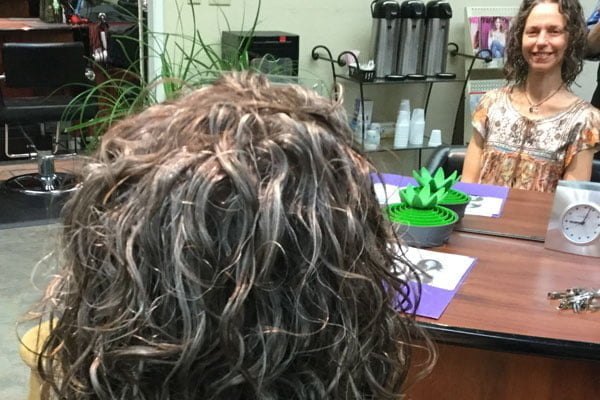
 I sat in the hairdresser’s chair, elevated enough so that I could see my reflection in the mirror before me. I asked her to take a photo from the back to show my long tresses, flowing in waves and soft curls almost down to my waist. This was going to be a big change, and I wanted to have a visual memory of it.
 I sat back in the chair in front of the mirror and opened my eyes. There I was, with a new, short, curly-do.
 The morning I wrote this post, I took a Tai Chi class. I find this practice challenging in a different way than I’m used to with yoga. Every time I have taken a class – only a handful of times – I try my best to “get” the movement of the energy and enjoy it.
 School’s out and summer is here. I’m ready to relax – how about you?