by Connie Habash | Oct 23, 2013 | Meditation, Patience, Play, Presence, Quiet, Satisfying, Soul, Writing
 There’s something fulfilling for me about writing by hand with a pen. The contact of the pen on paper, my hand sliding across the page, the flowing movements, and especially when I am pleased with the forms the letters take. It is very soul-satisfying.
Even when I cross-out words, I feel gratified. It is a definitive action. A declaration to delete something I no longer want, that I can see and own.
Handwriting is becoming a lost art in our computer age. No longer are schools in California required to teach cursive. This saddens me. As a calligrapher, I deeply appreciate the form and flow that come from my hand onto a page that no font on my computer can come close to.
In an effort to slow down and be present, as well as to become more productive in my writing, I’ve decided to take a few hours every week to go to my counseling office and write. Without my computer. No distractions. Just my quiet, beautiful space, a pen, and a notebook. In fact, I’m writing this in that space right now.
I love to make writing fun. I pick out pens and ink colors that are playful and please me. I explore varying the formation of the letters sometimes to see what I enjoy.
Occasionally, I study handwriting analysis to discover how I can change things in my life through changing my handwriting. Vimala Rogers has written a fine book about this if it speaks to you.
Handwriting can be another form of meditation. Calligraphers through the millennia have known this. I know I’m more present and at ease when my letters flow and loop in that gratifying way. I steady my breath, my eyes, and my hand as I ease it slowly across the page.
There are days when it is a struggle to slow down and to quiet my mind. My handwriting reflects this, with chaotic movements, difficulty controlling the pen, displeasing shapes. It’s OK. I try to slow down and form my letters more carefully. They may not improve much, but when I’m mindful about this, it helps my thoughts to calm down. I slow down my breath. I come back to the present and the letters emerging on the page.
I feel connected to the words in a visceral way through handwriting. It is easier to write from my heart, my spirit – even from my body itself – when the pen is mindfully grasped between my fingers.
I invite you to take pen in hand. How does it feel as you write? What do you notice about yourself, in mind, breath, body, heart? Let any words, thoughts, feelings come to you. What feels satisfying about it? What does it bring up? Let it slow you down and bring you into the present moment.
What else brings deep satisfaction to you? Make some time this week to give yourself that. Let me know how it goes.
by Connie Habash | Aug 16, 2013 | Being, Freedom, Growth, Love, Presence, Space
 For several weeks, I’ve been contemplating the nature of many things in the universe, including the nature of the Divine. I believe and feel that God is the source of love, and indeed is the energy of Love itself.
But in further exploring this idea, I realized that I needed to more deeply understand what I felt about the Divine. If God is Love, then what is Love? Because we all have different experiences and interpretations of love, it may cloud our true understanding of what that Infinite Consciousness or Intelligence is. We must come to a clear understanding of what Love is in order to understand God.
Many of us, consciously or unconsciously, have ideas of love. Some are based on what we did or didn’t receive as children growing up. Other ideas come from relationships we’ve had. And still other concepts come from what we’ve observed in the world or read in books.
Most of us base our concepts of love on what we feel inside. While I respect the power of feelings and the importance of honoring them and working with them, it can be a little deceptive to interpret love simply based on what we feel.
Why is that deceptive? Because feelings change. For example, many of us think we feel love when we’re “falling in love” with someone. We’re elated, we feel great, the world looks rosy. The thrill of being loved by another is ecstatic. It can be lusty, romantic, sweet, and make us feel worthwhile. At the same time, if circumstances change and we are rejected or betrayed, that same love can feel like jealousy, rage, despair, or hopelessness.
Is that love?
We often think of love when we think of our children. Certainly, there’s nothing like the love that a mother or father has for their child. It is elating, especially in those first weeks after birth. It is joyous, like when our little girl or boy runs to us with arms wide and throws themselves into our embrace. Being loved by a child touches us deeply, inspiring in us joy, responsibility, pride, and nurturance.
But this love also is painful, like the first time our toddler hits their head and cries like the world is over, or when they’re in bed with a fever. Our hearts ache for them, and we so much want to take away their suffering. Love for our children is also painful when our teen says they hate us, or slams the door on us. When our children don’t behave the way we want them to, love can feel like anger or frustration.
Is this really what love is? Does love change depending on the circumstance, or is love consistent, steady, always blissful? Or is it something else?
Well, clearly there are differences between the love we have for our favorite ice cream (love? really?), the love we have for our partner, the love we have for our parent or our children, and the love we have for the Divine. I could discuss the differences between them, but that’s really another article…
What I truly want to know and understand is, what is Divine Love? What is the Love, with a capital L, that I experience from and as God?
When I asked the question, answers started showing up. I was listening to a series of recordings by Dr. Vasant Lad, a renowned Ayurvedic doctor, about the essentials of the practice of Ayurveda, the health science of India. As he was describing the qualities of the 5th element, Space or Ether, he said something that surprised me. “Freedom is Love, and Love is Space.”
Huh? What did he mean by “Freedom is Love”? And why did he see Love as space?
It brought to mind the familiar quote: “If you love something, set it free. If it returns to you, it’s yours. If it doesn’t, it never was.” Giving someone the freedom to be who they are, without judgment or expectation, is a great act of love.
And that is exactly what the Divine has given us. The Creator gave us the universe in which to explore our lives, and the freedom to choose our actions, attitudes, and responses to life. So if the Divine is indeed Love itself, and it is everywhere present and infinite, then it makes sense that Love itself is that spaciousness of our universe and the freedom within it to explore, discover, and co-create.
A different take on Love comes from M. Scott Peck, author of the classic, The Road Less Traveled. He was, of course, describing love in relationship, but his view of love is just as applicable to the Sacred. Peck defines love as “the furthering of the growth of another.”
For lovers who choose to commit to a life together, or even just a season together, there is no greater love than supporting our partner in their evolution as a human and spiritual being. It is also what we sign up for as parents, nourishing the growth and development of our children.
Indeed, the Divine, too, seems to express as Love that furthers our spiritual evolution. Every situation and even every moment in life is rich with possibilities to learn, to open our hearts, to discover our true nature, and to expand our consciousness. We are given a grand universe and a life in which to grow and unfold into our greatest potential.
As I continued my query of What is Love, I remembered a sweet little book I had on a bookcase next to my desk at home. It’s called True Love, by Vietnamese Zen Buddhist monk Thich Nhat Hahn. Chapter number two says it very plainly: “To love, in the context of Buddhism, is above all to be there.” It’s presence.
He suggests that we practice this mantra with ourselves and those we love: “Dear One, I am here for you.” Don’t we feel most loved when someone takes the time to be present with us? To listen, to accept, to understand, to give us safe space to just be ourselves with them?
Whenever we are being present, we are Being Love. We recognize our connection to the one that we are present with. In that moment, we open to Oneness, to the Divine flowing through us, as us.
These three perspectives bring together, for me, a greater understanding of what Divine Love is. No wonder we all long for freedom, for space to be ourselves, for support in our growth, and for someone to be there for us. That is Love… and that is our greatest potential.
Do you have definitions of Divine Love to add to the list? Post them here!
Copyright @ 2013 by Rev. Connie L. Habash
by Connie Habash | Jun 11, 2013 | Awareness, Challenges, Choices, Contentment, Emotions, Fear, Presence
 We all have times when we’re faced with fears or challenges. It’s part of life.
But sometimes those challenges seem overwhelming. Our minds blow them up into crises, replaying the many terrifying, possible scenarios over and over again in our minds, until we become agitated, anxious, or immobilized.
Are any of those scenarios actually happening? Chances are pretty good that they aren’t. But our bodies do not know the difference. When the mind creates images and thoughts that are fearful, our bodies react with the same chemicals that are produced when we are faced with a true threat to our life.
Which means that we are creating unnecessary stress and trauma in our minds, with little or no basis in reality. But it doesn’t have to be this way.
Does this help us solve the problem? Not likely. It’s only harming us, with little if any benefit.
You don’t have to do this. You can bring your mind back to reality, and back to inner peace. The yogis call this Santosha. It’s the inner feeling of contentment, of accepting what is, of knowing that underneath all the external appearances, we’re OK. It’s a solid foundation within.
Tapping into Santosha allows you to better respond when in difficult situations. What is more effective in a crisis – becoming stressed and freaking out, or remaining calm, cool, and collected?
Here are some simple steps to help return you to Santosha. Because Santosha is always within you. It’s just that sometimes we forget and lose our way there.
1) Breathe. That’s always the first step, no matter what you’re doing. Be conscious of your breath. This helps to bring you back to reality in this present moment (chances are, you’re just sitting here, breathing, in front of the computer, not actually in the scenario you’re playing over and over in your head.)
2) Assess the situation. Take some time to consider what is actually and presently occurring in the situation. Stick with the facts.
3) Feel your emotions. Running away from the fear, or trying to deny it, only serves to intensify the emotion. Feel the sensations of the emotion in your body, like tension, pressure, or restlessness, and breathe into the sensations. If you give this some time, they’ll begin to shift.
4) Consider your choices. Come up with a list of your options to respond to the situation, including no response at all. Feel into the ramifications of each action.
5) Act. Do what is appropriate to do right now. It can include the decision to wait a few days before you decide how to act. It may also include no action, prayer, offering loving support, setting a firm boundary, asking for help. You may realize you can’t do anything right now. Just see what is available and appropriate right now.
6) Let it go. When you’ve taken whatever action feels right and is appropriate to do right now, then let it go. When we let go, we let God, as it is often said. This allows something greater than us to do the big work. It is an act of trust that there are larger shoulders than us that carry this situation. It also is a recognition that there is nothing else for you to do right now. If you need to follow up with another action at a later date, you’ll know.
7) Breathe. Return yourself to this moment, just as it is. Breathing in, breathing out.
Check in with yourself. After doing all seven steps, feel the shift out of the mind and into the present. When we’re in the present, Santosha awaits us, wondering where we’ve been.
Copyright © 2013 by Constance L. Habash
by Connie Habash | Feb 12, 2013 | Acceptance, Appreciation, Impermanence, Now, Presence
 My 8 year old daughter asked me last night, “Why is it called Butterfly? What does butter have to do with it? Who came up with that name?” I had to admit I didn’t know. But it made me think of how often we use words or phrases without paying much attention to what we’re actually saying.
For instance, I heard a familiar phrase today as if for the first time: “It came to pass.” It’s commonly found in the bible, as a kick-starter for some sort of story or allegory. Hmmm… to pass. That means something was temporary, a happening. Something was just moving on through, as time passes by. After all, the phrase isn’t “it came to stay.”
It speaks of the temporary nature of everything. The universe is constantly changing. You and I are constantly changing. You can’t hold onto to anything, just like you can’t cling to water. Everything is going to pass – even this life.
This keeps me in the present moment. I’d do well to enjoy this now, to be present with this now, because in the next moment it will have passed… and something new will emerge.
I’m in pain? It will pass. What is it like? How does this experience touch me and teach me?
I’m in joy? It will pass. What is it like? How can I appreciate it without clinging to it? What does it reveal?
The only thing – absolutely the only thing – that doesn’t pass is the consciousness with which we watch everything passing. That’s the Source. There’s only One Presence that witnesses it all, and it’s our True Nature.
Otherwise, we’d have no One reading “it came to pass…”
by Connie Habash | Oct 31, 2012 | Acceptance, Buddha, Choices, Happiness, Illusion, Judgment, Nonattachment, Now, Presence, Right Action
The funniest thought arose in my meditation today, after I had been contemplating the Eightfold Noble Path – Buddha’s prescription for eradicating suffering and attaining liberation. Apparently, my thoughts weren’t entirely still (big surprise) and thus this image of an ice cream cone being offered to the Buddha somehow sprang to my awareness. Would he eat it? What would the Buddha do?
I can’t claim to know what the Buddha would do, to be quite frank. But, based on his teachings, I can certainly take a stab at it. There’s one thing I do know – the Buddha would be aware that he has choices. He can choose to eat it, he can choose not to eat it. He would know that any desire or aversion that arose regarding the ice cream would be continuing the cycle of suffering in this life. He also knows that judgment would be a slippery slope – it feeds the ego, the idea that we are right if we choose one way, and wrong if we choose another. This would lead to either pride or shame, which again is back on the hamster wheel of suffering.
Therefore, he couldn’t say “No! It is wrong to eat ice cream – it’s bad for you, and will increase your desires, and therefore your suffering!” He also couldn’t simply indulge, giving in to a craving for the sweetness. He would probably be considering what Right Action to take – one of teachings of the Eightfold Path. What’s a Buddha to do?
He could decide not to eat it, plain and simple. He could decide not to eat it, but thank the person who offered it for their kindness in the offering. He could decide to taste it and experience the pleasantness of the flavor and texture as an expression of Maya, or the illusory state of the material world. He could decide to eat it, and recognize the temporary experience of the ice cream, from its taste on the tongue to how quickly it melts. He could eat it or not eat it, and recognize that the pleasure or pain he experienced from either choice is not his true nature, and that eating it or not eating it will not give him true happiness. Who really knows what the Buddha would do?
But one thing is for sure – whatever he chooses, he will forget about it in the next instant. He won’t even be thinking about the ice cream ever again, because he is firmly established in the eternal now, the ultimate reality, that transcends any of the temporary fluctuations of thought or form. So once he did whatever he did, he’d be done with it.
What do you think the Buddha would do?


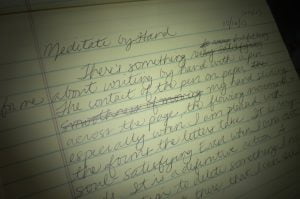 There’s something fulfilling for me about writing by hand with a pen. The contact of the pen on paper, my hand sliding across the page, the flowing movements, and especially when I am pleased with the forms the letters take. It is very soul-satisfying.
 For several weeks, I’ve been contemplating the nature of many things in the universe, including the nature of the Divine. I believe and feel that God is the source of love, and indeed is the energy of Love itself.
 We all have times when we’re faced with fears or challenges. It’s part of life.
 My 8 year old daughter asked me last night, “Why is it called Butterfly? What does butter have to do with it? Who came up with that name?” I had to admit I didn’t know. But it made me think of how often we use words or phrases without paying much attention to what we’re actually saying.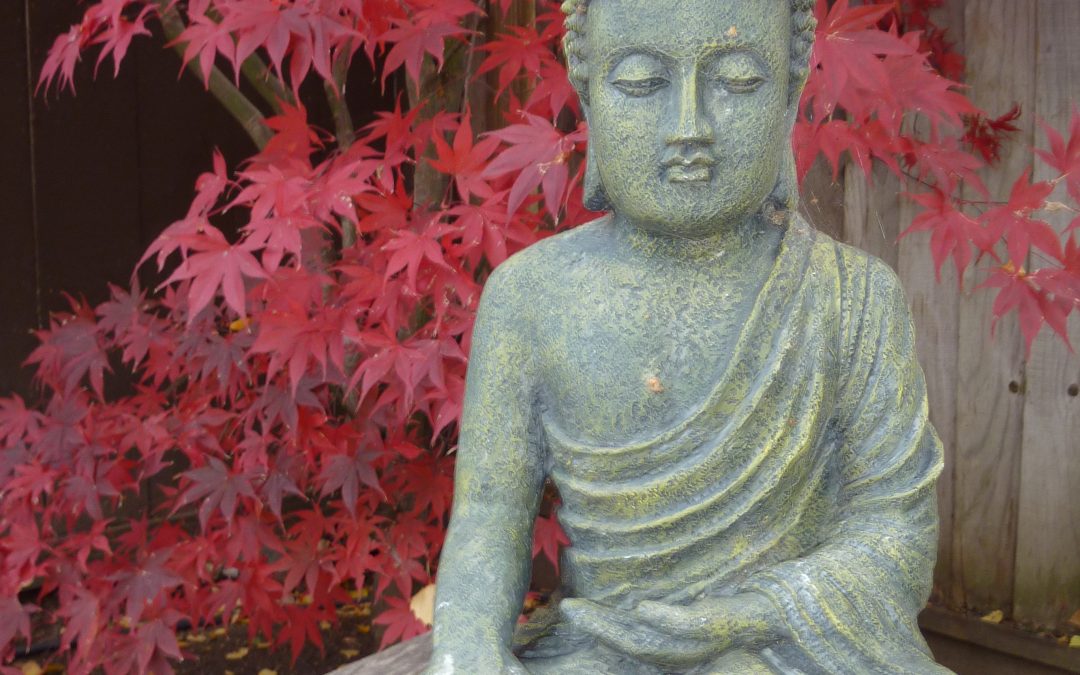
 The funniest thought arose in my meditation today, after I had been contemplating the Eightfold Noble Path – Buddha’s prescription for eradicating suffering and attaining liberation. Apparently, my thoughts weren’t entirely still (big surprise) and thus this image of an ice cream cone being offered to the Buddha somehow sprang to my awareness. Would he eat it? What would the Buddha do?